How to Migrate from SendGrid to Amazon SES (Step-by-Step)
Quick summary: Migrating from SendGrid to SES is mostly cheap — until your warm-up plan is wrong and deliverability falls off a cliff. DNS cutover, IP warming, API surface differences, and the deliverability checkpoints that keep email landing in inboxes through the switch.
Key Takeaways
- Migrating from SendGrid to SES is mostly cheap — until your warm-up plan is wrong and deliverability falls off a cliff
- DNS cutover, IP warming, API surface differences, and the deliverability checkpoints that keep email landing in inboxes through the switch
- SendGrid has been a go-to email service for years, but rising costs, pricing model changes, and the desire for deeper AWS integration are driving many organizations to Amazon SES
- June 2026 update — two SES releases that change the migration playbook: - June 1, 2026 — Tenant-level suppression lists
- SES now lets you set suppression scope to (in addition to the existing scope) and configure which reasons ( , , or both) feed each tenant's list

Table of Contents
SendGrid has been a go-to email service for years, but rising costs, pricing model changes, and the desire for deeper AWS integration are driving many organizations to Amazon SES. The migration is straightforward when done right — and disastrous when done wrong.
This guide walks you through the migration process step by step, with practical advice from having helped dozens of organizations make the switch without losing a single email to the spam folder.
June 2026 update — two SES releases that change the migration playbook:
- June 1, 2026 — Tenant-level suppression lists. SES now lets you set suppression scope to
TENANT(in addition to the existingACCOUNTscope) and configure which reasons (BOUNCE,COMPLAINT, or both) feed each tenant’s list.PutSuppressedDestination,GetSuppressedDestination,DeleteSuppressedDestination, andListSuppressedDestinationsall accept aTenantNameparameter. If you are migrating a SaaS, an agency that sends for multiple brands, or any platform where one tenant’s complaints should not silence delivery for the rest — design Step 2 around tenants from day one. See AWS docs on tenant-level suppression. - May 29, 2026 — Global deliverability in Virtual Deliverability Manager. VDM now reports inbox placement rates (by sending domain and campaign, sampled from representative industry data) and blocklist monitoring, available in every commercial AWS region where SES is offered. You can also pro-actively test candidate email content to estimate inbox placement at top mailbox providers before you press send. Third-party seed-list tools (GlockApps, Litmus, 250ok) still help, but VDM is now the native source of inbox-vs-spam visibility. See Virtual Deliverability Manager global deliverability.
May 2026 deliverability reality check: Major mailbox providers now enforce authenticated bulk sending. Google and Yahoo tightened requirements in February 2024 (SPF/DKIM alignment, DMARC publishing, functional unsubscribe flows for bulk mail). Microsoft expanded comparable Outlook.com / Hotmail bulk-sender rules effective May 5, 2025—including DMARC (at minimum p=none for large senders), working SPF/DKIM, and list-hygiene expectations. SES publishes guidance for staying aligned—start at Navigate bulk sender requirements with Amazon SES and use the console guided onboarding paths for DKIM, custom MAIL FROM, and DMARC records.
Why Teams Migrate from SendGrid to SES
Cost
The cost difference is the primary driver for most migrations. SendGrid’s Pro plan starts at $89.95/month for 100,000 emails. SES charges $0.10 per 1,000 emails — that same 100,000 emails costs $10. At higher volumes, the gap widens dramatically.
Pricing Note: Pricing as of February 2026. Both SendGrid and AWS SES pricing change periodically. Verify current rates at SendGrid Pricing and AWS SES Pricing.
| Monthly Volume | SendGrid Pro | AWS SES | Annual Savings |
|---|---|---|---|
| 100,000 | $89.95/mo | $10/mo | $959 |
| 500,000 | $249/mo | $50/mo | $2,388 |
| 1,000,000 | $449/mo | $100/mo | $4,188 |
| 5,000,000 | Custom (~$1,500) | $500/mo | ~$12,000 |
AWS Integration
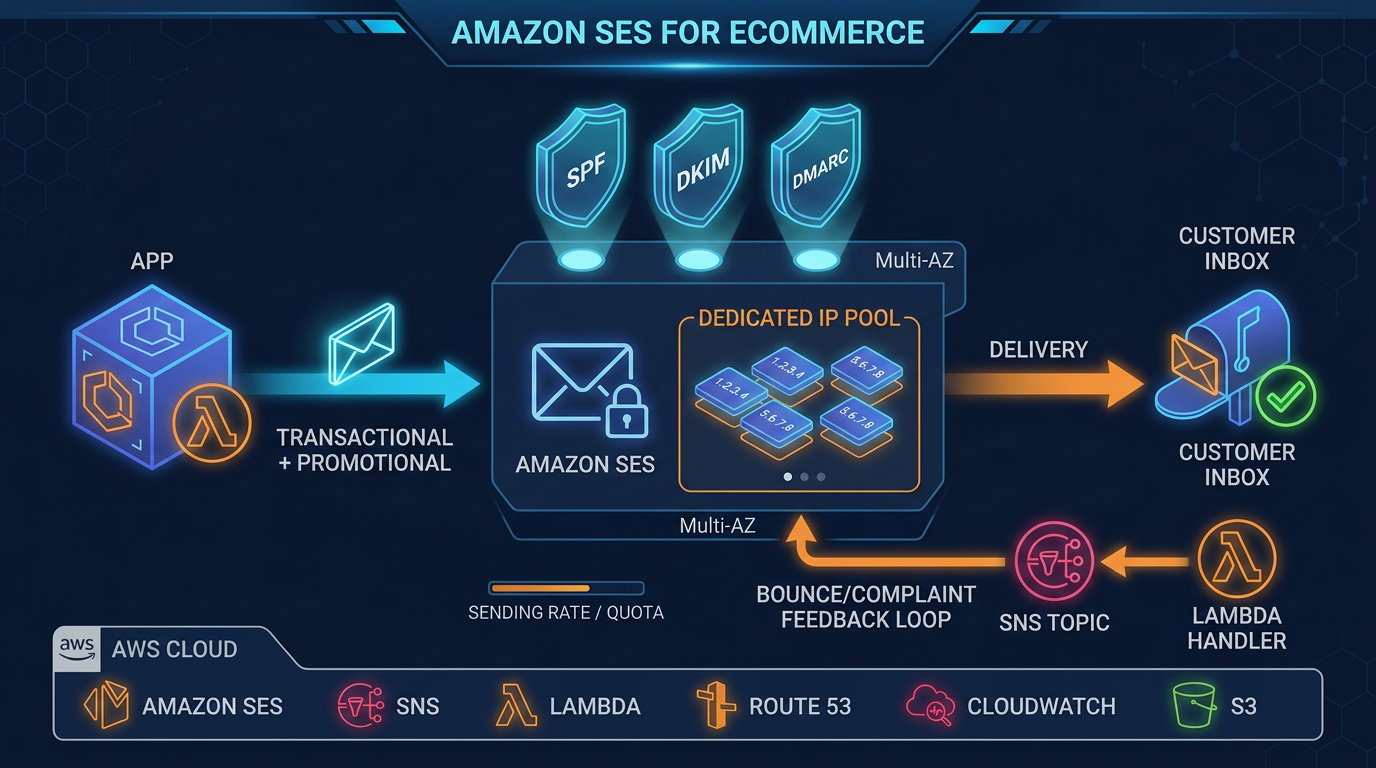
If your infrastructure is already on AWS, SES integrates natively with Lambda, SNS, SQS, CloudWatch, S3, and Kinesis. This eliminates webhook complexity, enables real-time event processing, and keeps data within your AWS account.
Control and Flexibility
SES gives you direct control over dedicated IPs, sending configuration, and event processing that SendGrid abstracts away. For engineering teams that want granular control over their email infrastructure, SES provides it.
Pre-Migration Planning
Before changing a single DNS record, plan the migration carefully.
Audit Your Current SendGrid Setup
Document everything you are currently using in SendGrid:
- Sending domains — Which domains and subdomains are configured for sending?
- Authentication — Current SPF, DKIM, and DMARC records (note the selector names)
- Dedicated IPs — How many, and what is their current reputation?
- API integrations — Which applications send through SendGrid’s API? What endpoints and libraries are used?
- SMTP integrations — Which systems use SMTP relay through SendGrid?
- Event webhooks — Where are delivery, bounce, complaint, and click events being processed?
- Templates — Are you using SendGrid’s template engine, or are templates rendered application-side?
- Suppression lists — Export your bounce and unsubscribe lists — you will need these in SES.
Set Up Your SES Environment
Before cutting over, prepare SES in parallel:
- Request production access — New SES accounts start in sandbox mode (limited to verified addresses). Request production access via the AWS console — approval typically takes 24-48 hours.
- Verify domains — Add your sending domains to SES and complete domain verification via DNS TXT records.
- Enable DKIM — Configure Easy DKIM for each domain. SES generates three CNAME records to add to your DNS.
- Request dedicated IPs — If you are migrating from SendGrid dedicated IPs, request dedicated IPs in SES ($24.95/month each). Decide between managed warm-up pools or manual warm-up.
- Set up configuration sets — Create configuration sets for event tracking, with event destinations pointing to SNS, CloudWatch, or Kinesis.
Step-by-Step Migration
Step 1: Configure DNS Authentication
This is the most critical step. Get it wrong and your deliverability will suffer immediately.
SPF: SES uses amazonses.com as the sending IP source. Update your SPF record to include SES while keeping SendGrid during the transition:
v=spf1 include:sendgrid.net include:amazonses.com ~allAfter migration is complete, remove the SendGrid include.
DKIM: SES Easy DKIM uses its own CNAME records (three per domain). These coexist with SendGrid’s DKIM records during transition — DKIM allows multiple valid signatures.
DMARC: If you have DMARC configured, ensure your policy accommodates both SendGrid and SES during the transition period. A p=none policy during migration reduces risk.
Step 2: Migrate Your Suppression List
Export your bounce, complaint, and unsubscribe lists from SendGrid and import them into SES:
- Hard bounces → Add to the SES suppression list — account-level by default, or tenant-level if you are migrating a multi-tenant platform (new since June 1, 2026)
- Complaints → Add to the suppression list at the same scope you chose for bounces
- Unsubscribes → Handle in your application layer (SES does not have a built-in unsubscribe management system like SendGrid)
Skipping this step is the most common migration mistake. Sending to previously bounced or complained addresses from a new IP will destroy your reputation immediately.
Suppression scope decision (new June 1, 2026): If a single AWS account sends for multiple end-customers — SaaS multi-tenant, an agency running multiple brands, a marketing platform serving retailers — pick tenant-level suppression so a complaint from one tenant’s recipients does not suppress delivery for the rest of the roster. The API surface is the same operations you already know (PutSuppressedDestination, GetSuppressedDestination, DeleteSuppressedDestination, ListSuppressedDestinations) with a TenantName parameter. Existing single-product senders can stay on account-level scope.
Step 3: Warm Up Dedicated IPs
If you are using dedicated IPs (recommended for volumes over 100,000/month), you must warm them up. A cold IP sending thousands of emails on day one will be throttled or blocked by Gmail, Microsoft, and Yahoo.
Warm-up schedule:
| Week | Daily Volume | Strategy |
|---|---|---|
| 1 | 200-1,000 | Send to your most engaged subscribers only |
| 2 | 1,000-5,000 | Expand to recent openers/clickers |
| 3 | 5,000-25,000 | Broaden to full engaged list |
| 4 | 25,000-100,000 | Approach target volume |
| 5+ | Full volume | Monitor and adjust |
During warm-up, split your sending: warm-up volume goes through SES, remaining volume stays on SendGrid. This parallel sending approach ensures no emails are lost during the transition.
SES also offers managed warm-up pools that handle this automatically — new dedicated IPs are placed in a shared warm-up pool and gradually transitioned to your dedicated pool as they build reputation.
Step 4: Update API Integrations
Replace SendGrid API calls with SES API calls. The interfaces are different:
SendGrid v3 API uses a REST endpoint with JSON payloads and API key authentication.
SES v2 API uses the AWS SDK with IAM-based authentication. If your application already uses the AWS SDK for other services, SES integration is straightforward.
Key differences to handle:
- Authentication — SendGrid uses API keys; SES uses IAM roles and AWS credentials. Use IAM roles attached to your EC2 instances, ECS tasks, or Lambda functions rather than hardcoded access keys.
- Rate limiting — SES has per-second and per-day sending quotas. Request quota increases as needed through the AWS console.
- Template rendering — If you use SendGrid’s template engine, you will need to migrate templates to SES templates, your application, or a templating library.
- Event handling — Replace SendGrid event webhooks with SES → SNS → Lambda/SQS event processing. This is actually more reliable because it uses AWS’s managed messaging infrastructure.
Step 5: Migrate SMTP Integrations
For systems that send via SMTP relay (legacy applications, WordPress sites, transactional email from third-party tools):
- SES provides SMTP credentials generated from IAM users
- The SMTP endpoint is
email-smtp.{region}.amazonaws.comon port 587 (TLS) or 465 (SSL) - Update SMTP settings in each application, replacing SendGrid’s SMTP server, username, and password
Step 6: Set Up Monitoring
Replace SendGrid’s dashboard with SES monitoring:
- CloudWatch metrics — Send, delivery, bounce, and complaint rates with alarms on threshold breaches
- SNS notifications — Real-time alerts for bounces, complaints, and delivery failures
- CloudWatch Logs — Detailed delivery logs for troubleshooting
- SES reputation dashboard — Account-level bounce and complaint rate monitoring
- Virtual Deliverability Manager (VDM) — Since May 29, 2026, VDM is the native source for inbox placement rates (per sending domain and campaign) and industry blocklist monitoring, available in every commercial AWS region where SES runs. Enable VDM on the configuration sets you migrate so you can see Gmail / Outlook / Yahoo placement gaps without a third-party seed list
Step 7: Cut Over and Decommission SendGrid
Once your SES dedicated IPs are warmed, integrations are migrated, and monitoring is in place:
- Route all sending through SES
- Remove SendGrid includes from your SPF record
- Monitor deliverability closely for 2-4 weeks
- Decommission your SendGrid account
Common Migration Pitfalls
Pitfall 1: Skipping Suppression List Migration
Sending to addresses that previously bounced or complained is the fastest way to get your new IPs blocklisted. Always import your suppression lists before sending a single email from SES.
Pitfall 2: Sending Full Volume from Cold IPs
Mailbox providers (Gmail, Microsoft, Yahoo) are skeptical of new IPs sending high volumes. Follow a warm-up schedule. There are no shortcuts.
Pitfall 3: Ignoring DMARC Alignment
If your DMARC policy is set to p=reject and your SPF/DKIM records are not properly configured for SES, your emails will be rejected. Temporarily set DMARC to p=none during migration and tighten it after verification.
Pitfall 4: Not Handling Unsubscribes
SendGrid manages unsubscribe lists. SES does not. You must handle unsubscribe processing in your application layer — list-unsubscribe headers, one-click unsubscribe links, and suppression list management.
Pitfall 5: Hardcoding AWS Credentials
Never embed AWS access keys in application code. Use IAM roles for EC2, ECS, and Lambda. Use AWS Secrets Manager for applications running outside AWS.
Post-Migration Optimization
Once the migration is complete and stable, optimize your SES setup:
- Implement sending analytics — Stream SES events to Kinesis Data Firehose → S3 for long-term analytics on engagement, deliverability by provider, and campaign performance.
- Set up A/B testing — Test subject lines, send times, and content variations using SES configuration sets with different event destinations.
- Optimize send times — Analyze engagement data to identify optimal sending windows for different audience segments.
- Review inbox placement — Lead with VDM’s native inbox placement metrics (released May 29, 2026) for everyday visibility; complement with third-party seed-list tools (GlockApps, Litmus) when you need rendering checks or targeted ISP probes.
Need Help with Your Migration?
Migrating email infrastructure carries real risk — a misstep can affect your sender reputation and deliverability for weeks or months. Our team has migrated organizations sending millions of emails per month to SES without deliverability disruption.
See our SES Migration & Email Delivery Services for details, or learn about our broader AWS SES solutions for ongoing optimization and management.
Contact us to plan your SendGrid to SES migration →
E-commerce campaign patterns are in AWS SES for ecommerce email.
AWS Cloud Architect & AI Expert
AWS-certified cloud architect and AI expert with deep expertise in cloud migrations, cost optimization, and generative AI on AWS.