Migrate from Terraform to OpenTofu: What AWS Teams Need to Know
Quick summary: Terraform to OpenTofu migration: compatibility, risks, tools, and production deployment patterns for AWS infrastructure.
Key Takeaways
- Terraform to OpenTofu migration: compatibility, risks, tools, and production deployment patterns for AWS infrastructure
- OpenTofu reached general availability in January 2024
- For AWS teams, OpenTofu is a strategic move: drop-in compatible with Terraform, vendor-independent, and guaranteed to remain open source
- For AWS teams, there's zero reason NOT to migrate
- 5-Step Migration Process Step 1: Audit Current Terraform Setup (Day 1) Checklist: - ✓ How many AWS resources
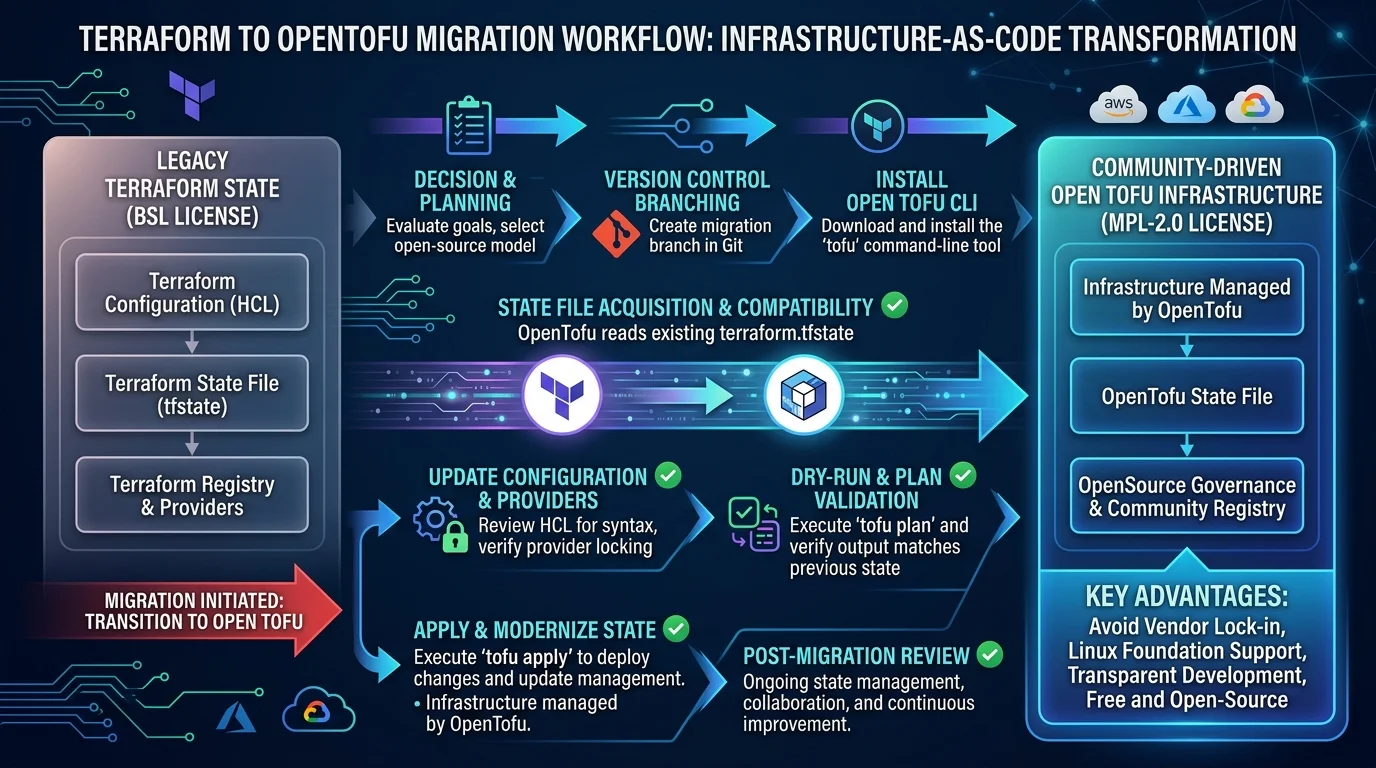
Table of Contents
The Terraform → OpenTofu Shift
In August 2023, HashiCorp changed Terraform’s license to BUSL (Business Source License), sparking the open-source community to fork the project into OpenTofu — a 100% open-source, community-governed alternative. OpenTofu reached general availability in January 2024.
For AWS teams, OpenTofu is a strategic move: drop-in compatible with Terraform, vendor-independent, and guaranteed to remain open source. No cost changes. No code changes. Just better long-term positioning.
OpenTofu vs. Terraform: The Comparison
| Aspect | Terraform | OpenTofu |
|---|---|---|
| License | BUSL (proprietary) | MPL 2.0 (open source) |
| Cost | Free tier (basic features), Enterprise $$$ | Free, forever |
| AWS Support | Full | Full (100% compatible) |
| State File | Interchangeable | Interchangeable |
| HCL Syntax | Standard | Identical |
| Provider Ecosystem | Official AWS provider | Same AWS provider |
| Community | HashiCorp-led | Open-source community |
| Feature Parity | Baseline | 100% compatible |
Bottom line: OpenTofu is Terraform without the vendor lock-in. For AWS teams, there’s zero reason NOT to migrate.
5-Step Migration Process
Step 1: Audit Current Terraform Setup (Day 1)
# Count resources and modules
terraform state list | wc -l

# Check provider versions
terraform version

# Export state
terraform show > current_state.txt
Checklist:
- ✓ How many AWS resources?
- ✓ What Terraform version?
- ✓ Any custom providers or modules?
- ✓ How many workspaces?
Step 2: Install OpenTofu (30 minutes)
macOS:
brew install opentofu
tofu version
Linux:
curl --proto "=https" --tlsv1.2 -fsSL \
  https://get.opentofu.org/linux/opentofu.asc | gpg --import

curl --proto "=https" --tlsv1.2 -fsSL \
  https://releases.hashicorp.com/opentofu/1.6.0/opentofu_1.6.0_linux_amd64.zip | gunzip

sudo mv opentofu /usr/local/bin/
tofu version
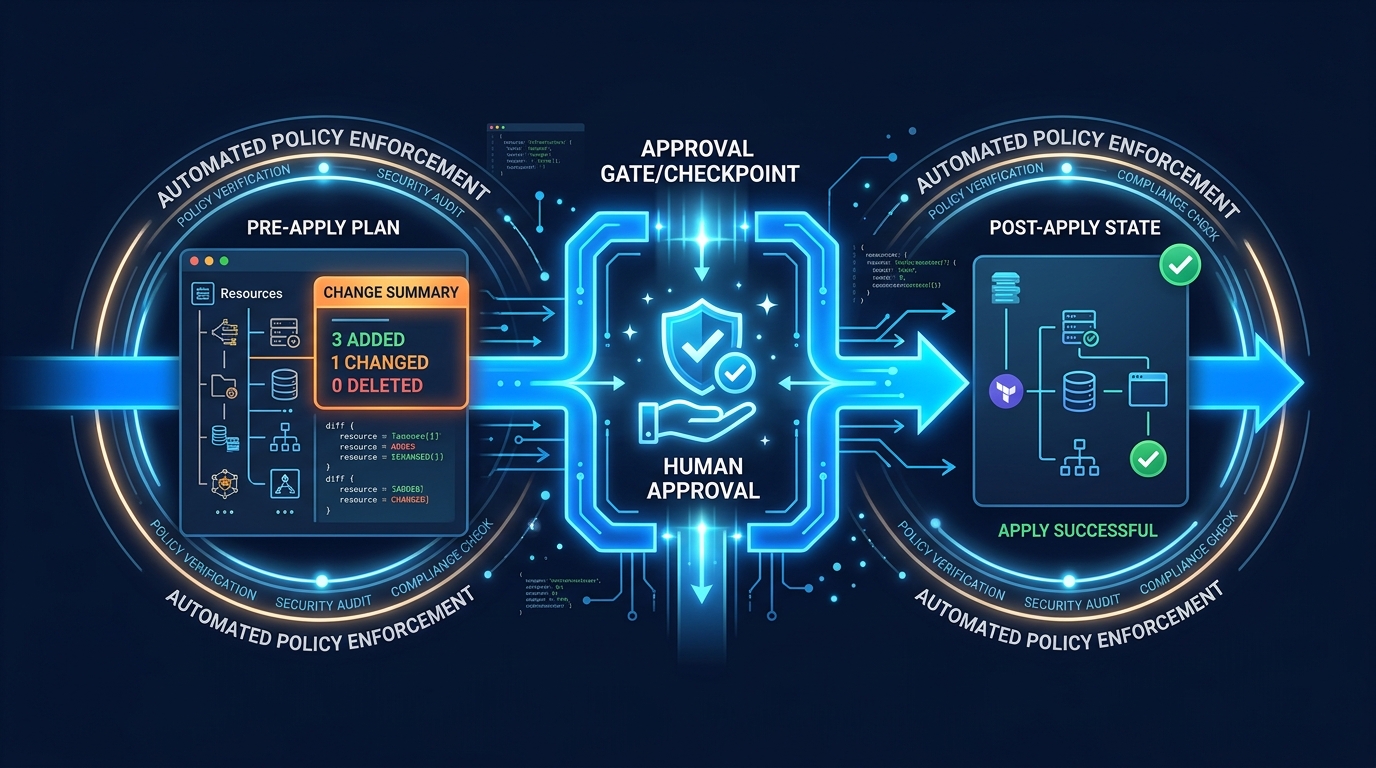
Step 3: Test in Staging (Day 2)
# Clone your Terraform project to a staging branch
git checkout -b opentofu-migration

# Remove Terraform lock file (OpenTofu will regenerate)
rm .terraform.lock.hcl

# Initialize OpenTofu
tofu init

# Plan without applying
tofu plan > opentofu.plan

# Compare with Terraform plan
terraform plan > terraform.plan

# diff to verify identical
diff terraform.plan opentofu.plan
What to check:
- ✓ No unintended changes in plan
- ✓ Same number of resources
- ✓ Identical variable handling
- ✓ State file compatibility
Step 4: Migrate State File (if needed)
If running Terraform with remote state (S3 + DynamoDB):
# Current Terraform configuration
cat main.tf
terraform {
backend "s3" {
bucket = "my-tfstate"
key = "prod/terraform.tfstate"
region = "us-east-1"
dynamodb_table = "terraform-locks"
}
}OpenTofu uses identical backend syntax:
# No changes needed! Just run:
tofu init

# Confirm it reads the same state:
tofu state list
The state file format is identical; no migration needed.
Step 5: Full Rollout (Week 1-2)
Canary approach:
# 1. Staging runs with OpenTofu (Week 1)
#    - Deploy to dev environment
#    - Run Smoke tests
#    - Monitor for issues

# 2. Pilot production run (Week 2)
tofu plan -out=production.tfplan

# 3. Approve and apply
tofu apply production.tfplan

# 4. Verify state
tofu state list | wc -l  # Should match previous terraform count
Validation Checklist
Before going 100% OpenTofu:
☐ All resources accounted for (tofu state list count matches)
☐ No unplanned resource changes
☐ Variables and locals work identically
☐ Modules resolve correctly
☐ Remote state accessible (S3/Terraform Cloud)
☐ Cross-account IAM roles work
☐ Automated plan/apply workflows tested
☐ Team trained on 'tofu' command (not 'terraform')
☐ CI/CD pipelines updated
☐ Documentation updated
☐ 2-week post-rollout monitoring complete
CI/CD Pipeline Updates
GitHub Actions Before (Terraform)
- name: Terraform Plan
  run: terraform plan

- name: Terraform Apply
  run: terraform apply -auto-approve
After (OpenTofu)
- name: OpenTofu Plan
  run: tofu plan

- name: OpenTofu Apply
  run: tofu apply -auto-approve
That’s it. Just swap the binary name.
GitLab CI
# Before
script:
  - terraform init
  - terraform plan

# After
script:
  - tofu init
  - tofu plan
Monitoring Post-Migration
Track State Synchronization
# Weekly: verify state matches reality
tofu refresh

# Monitor state file size (should be stable)
aws s3 ls s3://my-tfstate/prod/terraform.tfstate

# Check for lock file stuck issues
tofu force-unlock <LOCK_ID>  # if needed
Cost Changes
OpenTofu is free, so:
- Terraform Cloud/Enterprise → $0/month 🎉
- License compliance → simplified
- Community support → active community
Rollback Plan
If you need to revert to Terraform:
# OpenTofu state is compatible with Terraform
# Just switch back:

terraform init
terraform state list  # Same state, readable
terraform apply       # Will see no changes
Zero risk rollback. The migration is reversible.
Real-World Example: FactualMinds Infrastructure
Our setup:
- 250+ AWS resources
- 15 modules
- 3 environments (dev/staging/prod)
- 4 team members
Migration time:
- Audit: 4 hours
- Testing: 16 hours
- Rollout: 4 hours
- Post-validation: ongoing
Total effort: 24 hours spread over 2 weeks.
Cost savings: $500-1000/month (Terraform Cloud subscription eliminated).
Common Issues & Solutions
Issue: State Lock Timeout
Error: Resource instance managed by this state is being modified by another client.Solution:
tofu force-unlock <LOCK_ID>Issue: Workspace Mismatch
# List all workspaces
tofu workspace list

# Switch workspace
tofu workspace select prod
Issue: Old .terraform directory conflicts
# Remove Terraform cache
rm -rf .terraform/

# Reinitialize with OpenTofu
tofu init
Vendor Independence & Long-Term Strategy
By migrating to OpenTofu, you:
- Eliminate HashiCorp vendor lock-in
- Gain community-backed infrastructure code
- Ensure long-term open-source support
- Reduce licensing complexity
For AWS teams managing infrastructure as code, OpenTofu is the strategic choice for 2025+.
Related Resources
Ready to Migrate?
OpenTofu migration is low-risk and fast. Book a consultation to plan your infrastructure-as-code modernization.
Related reading
AWS Cloud Architect & AI Expert
AWS-certified cloud architect and AI expert with deep expertise in cloud migrations, cost optimization, and generative AI on AWS.