
10 AWS DevOps Practices We Actually Use in Production in 2026
Real AWS DevOps practices from production: GitOps on EKS, OpenTelemetry, supply chain security, chaos engineering with FIS, and AI-assisted DevOps with Amazon Q.
AWS Cloud Architect & AI Expert
AWS-certified cloud architect and AI expert with deep expertise in cloud migrations, cost optimization, and generative AI on AWS.
View ProfileReal AWS DevOps practices from production: GitOps on EKS, OpenTelemetry, supply chain security, chaos engineering with FIS, and AI-assisted DevOps with Amazon Q.
AWS support tiers differ wildly in response time and escalation. Managed support providers add proactive monitoring, incident response, and on-call coverage. Here is what 24/7 managed support actually means, how it differs from AWS support, and when you need it.

AWS Cloud Consulting Partners vary wildly in quality and capability. This guide explains AWS Partner tiers, what differentiates top partners from generalists, and concrete evaluation criteria for choosing a consulting partner aligned with your business.
AWS IoT architecture patterns for manufacturing, smart buildings, and connected devices — from device connectivity to data ingestion, edge processing with Greengrass, and real-time analytics.
SOC 2 Type II certification proves your controls are effective over 6-12 months. This guide covers the compliance roadmap, AWS security controls, documentation requirements, and audit preparation for 2026 certification.
Amazon Bedrock Agents automate workflows by giving foundation models the ability to call tools (APIs, Lambda, databases). This guide covers building agents with tool definitions, testing in the console, handling errors, and scaling to production.
Amazon Bedrock Knowledge Bases automate the RAG (Retrieval-Augmented Generation) pipeline — semantic search, chunking, embedding, and context injection into Claude or other foundation models. This guide covers setup, data ingestion, cost optimization, and production patterns.
AWS Glue automates ETL (Extract, Transform, Load) workflows while Athena provides serverless SQL queries. This guide covers building a complete data pipeline: ingesting raw data, transforming it, and querying at scale without managing servers.
AWS WAF protects APIs from SQL injection, XSS, DDoS, and account takeover attacks. This guide covers advanced WAF rules, rate limiting, bot control, and production patterns for defending REST APIs and GraphQL endpoints.
Karpenter replaces Kubernetes Cluster Autoscaler with intelligent bin-packing and just-in-time node provisioning. This guide covers setup, consolidation, cost optimization, and production patterns for EKS clusters.
Blue/green deployments eliminate downtime by running two identical production environments. Traffic switches from blue (old) to green (new) instantly. This guide covers CodeDeploy automation, health check validation, and rollback strategies for zero-downtime releases on AWS ECS.
HIPAA compliance on AWS requires encryption, audit logging, access controls, and Business Associate Agreements. This guide covers architecture patterns, AWS service configurations, and compliance validation for healthcare applications.
Migrating a monolith from on-premises or EC2 to ECS Fargate enables containerization and serverless compute. This guide covers zero-downtime migration: deploying containers, gradual traffic shifting, and rollback strategies.
Amazon SageMaker automates ML training, but instance costs add up fast. This guide covers spot instances, instance selection, distributed training, and production patterns to reduce SageMaker costs by 50-70%.
Amazon Bedrock Guardrails protect foundation models from harmful outputs — filtering on prompt injection, jailbreaks, toxicity, and PII. This guide covers setup, testing, cost optimization, and production safety patterns for GenAI applications.
Amazon Q for Business is a generative AI assistant for enterprise search and document retrieval. This guide covers setup with SharePoint and S3 data sources, user management, and production deployment patterns.
AWS Control Tower automates multi-account management — setting up guardrails, enforcing compliance policies, and centralizing billing. This guide covers setup, customization, and production governance patterns.
AWS Security Hub aggregates security findings from 200+ sources (GuardDuty, Config, IAM Access Analyzer, Inspector). This guide covers setup, compliance standards (PCI-DSS, CIS, NIST), automated remediation, and building a compliance dashboard without hiring a SOC team.
AWS Cost Anomaly Detection uses machine learning to flag unusual spending patterns — runaway EC2 instances, unexpected Lambda spikes, or compromised credentials. This guide covers setup, alerting, and automation to prevent bill shock.
Bedrock billing is not a single line item — it is a composition of model invocation costs, Knowledge Base retrieval, Agent orchestration, Guardrails evaluation, and cross-region inference profile routing. Each component has its own pricing model and its own set of cost traps.
AWS Cost Optimization Hub consolidates recommendations from Compute Optimizer, Trusted Advisor, and Cost Explorer into a single prioritized list with estimated annual savings. If you are running three separate cost review processes, this dashboard replaces all of them.
Nova Forge SDK, Lambda Durable Functions, Graviton5, Trainium3 UltraServers, Route 53 Global Resolver GA, and more — the AWS announcements that actually matter from March 2026.
Karpenter replaces Cluster Autoscaler as the recommended EKS node autoscaler. It provisions nodes faster, selects better-fit instance types per workload, and consolidates nodes more aggressively — typically reducing EKS compute costs by 20-40% compared to an equivalent Cluster Autoscaler deployment.

Autoscaling was supposed to make costs predictable by matching capacity to demand. Instead, it introduced feedback loops, burst amplification, and — with AI workloads — a new class of non-deterministic spend that no scaling policy anticipates.

Observability is not free, and the industry has collectively underpriced it. CloudWatch log ingestion, metrics explosion, and X-Ray trace volume can together exceed your compute bill — especially once AI workloads introduce high-cardinality telemetry at scale.

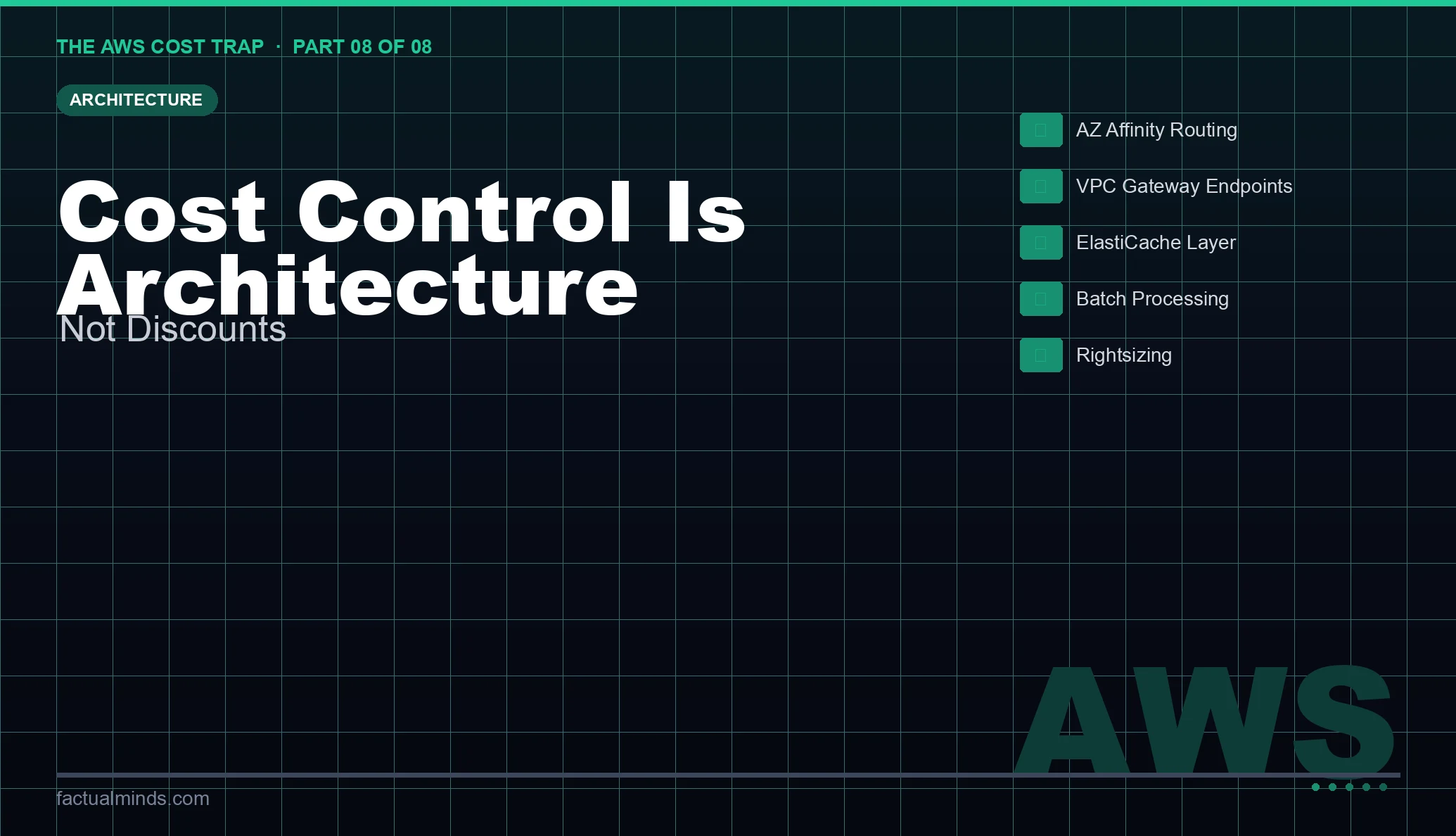
Savings Plans and Reserved Instances reduce the rate you pay. Architecture determines the volume you pay at. The most durable cost reductions in AWS come from designing systems that structurally generate less spend — not from negotiating a lower price for the same behavior.

Most AWS cost forecasts miss by 30–50% not because engineers are careless, but because the forecasting model does not match how AWS actually charges. This is the playbook for getting forecasts right: which metrics to measure, which models to use, and where the structural gaps are.

The most expensive AWS architectures are not the ones that use the most resources — they are the ones whose costs respond unpredictably to inputs. This is the design discipline for building systems where costs are structurally bounded and forecasting is accurate.

Data transfer is the most consistently underestimated cost in AWS architectures. It does not appear in compute estimates, it does not scale linearly, and it punishes microservices designs at exactly the moment growth feels like success.

AWS surprise bills from autoscaling follow a small set of repeatable failure patterns: feedback loops, scale-out without scale-in, burst amplification from misconfigured metrics, and commitment mismatches after scaling events. Each pattern has a specific fix.

The reason AWS cost problems grow undetected is not technical — it is organizational. Engineers make architectural decisions with no cost feedback. Finance sees bills 30 days late. No one owns the gap between the two.

AWS migration cost estimates are consistently wrong — not because the tools are bad, but because they miss the parallel run period, data transfer during migration, and the operational tax of learning a new environment. Here is what to actually model.

AWS publishes every price on a public page, yet bills still arrive as surprises. The problem is not opacity — it is that real costs emerge from interactions between services, not from any single line item.

S3 storage pricing is genuinely low. S3 request pricing, replication costs, and the compounding effects of versioning and lifecycle misconfiguration are not. Most expensive S3 bills have nothing to do with how much data you store.

The most expensive AWS bills do not come from large-scale systems under heavy load. They come from small systems with invisible failure modes: infinite retry loops, misconfigured queues, forgotten resources, and traffic patterns nobody anticipated.

CI/CD infrastructure is invisible until your DevOps bill hits $15,000/month. Build minutes, artifact storage, and ephemeral environments accumulate costs that few teams track. Here is how to measure and control them.

A B2B SaaS stack that costs $500/month at launch does not need to cost $50,000/month at 100,000 users if the architecture decisions at each stage are deliberate. This is the end-to-end reference architecture with real cost numbers.

A 500ms latency spike in a distributed system could be a slow RDS query, a Lambda cold start, a downstream API timeout, or a CloudWatch Logs ingestion delay. Finding the cause requires correlated logs, traces, and metrics — not grep.

A technical deep dive into EC2 performance optimization for API workloads — covering instance family selection, Graviton vs x86 economics, network tuning, EBS configuration, and Linux kernel parameters that directly impact throughput and tail latency.

RDS, Aurora, and self-managed Postgres each have a cost breakeven point. This guide covers total cost of ownership, connection pooling with PgBouncer, indexing strategies, and the edge cases that turn Postgres into a billing surprise.

A technical guide to hybrid compute architectures that combine EC2, Lambda, Fargate, and Step Functions — with worked cost calculations, SQS buffering patterns, and decision frameworks based on invocation pattern rather than unit cost.

MongoDB Atlas and self-hosted EC2 deployments have very different cost profiles at different scales. This guide covers TCO comparison, sharding strategies, index design for memory efficiency, and the edge cases that cause MongoDB costs to spiral.

Multi-region AWS architectures can easily cost 2–3× a single-region equivalent when data replication, cross-region transfer, and duplicated managed services are not accounted for. Here is how to architect for resilience without proportional cost growth.

FrankenPHP, Nginx+PHP-FPM, Node.js, Python Gunicorn+uvicorn, and Go each have different memory profiles, concurrency models, and failure modes. The right choice depends on your workload, not benchmarks.

SQS charges per API request. Retry storms, misconfigured visibility timeouts, and unlimited worker concurrency turn queue costs from predictable to catastrophic. Here is how to prevent it.

A deep technical guide to running PHP, Python, and Node.js applications on Amazon ECS in production — covering Fargate vs EC2, FrankenPHP vs Nginx+FPM, multi-container task patterns, zero-downtime deployments, and observability.

Attackers do not need to take down your service to hurt you — they can send traffic designed to maximize your AWS bill. DDoS amplification, Lambda invocation bombs, and SQS message flooding are billing attacks, not just availability attacks.

Redis and its fork Valkey reduce AWS costs beyond caching: rate limiting, session storage, and distributed coordination all have cheaper implementations via in-memory data structures than the AWS-managed alternatives. Here is how to use them.

SQS, MSK Kafka, and Redis queues are not interchangeable. Each has different cost models, ordering guarantees, and failure modes. This guide covers when to use each, how to autoscale workers on queue depth, and how to build idempotent consumers.

PHP-FPM, Node.js, Python, and Go have fundamentally different concurrency models. Tuning each runtime for high concurrency on ECS requires understanding the model, not just copying configuration values from Stack Overflow.

Build tooling has shifted from JavaScript-based (Webpack, Babel) to native-speed Rust and Zig runtimes (SWC, Rolldown, Bun). The CI/CD implications are real: 10× faster builds, smaller caches, and lower build minute costs on AWS CodeBuild and GitHub Actions.

Not every legacy application should be refactored into microservices. A decision framework for choosing the right modernization path — refactor, replatform, or rearchitect — based on business value, team capacity, and technical complexity.

The AWS Migration Acceleration Program (MAP) provides credits, tooling, and methodology to reduce the cost and risk of migrating to AWS. Here is how SMBs can take advantage of it.

The difference between a successful AWS migration and a costly failure often comes down to strategy. A practical guide to choosing the right migration approach, building your roadmap, and avoiding the pitfalls that derail most projects.

Cloud cost governance that actually sticks. A comprehensive guide to FinOps on AWS — the Inform/Optimize/Operate framework, AWS-native tools, team structure, and how to know when to hire a FinOps consultant.

Not all AWS expertise is equal. A practical guide to evaluating AWS consultants and partners — certifications that matter, red flags to avoid, questions to ask, and how to choose between a freelancer, agency, and AWS Partner.

A practical architecture guide for PCI DSS compliance on AWS — CDE scoping, the 12 requirements mapped to AWS services, network design, encryption, logging, and audit readiness for payment-processing applications.

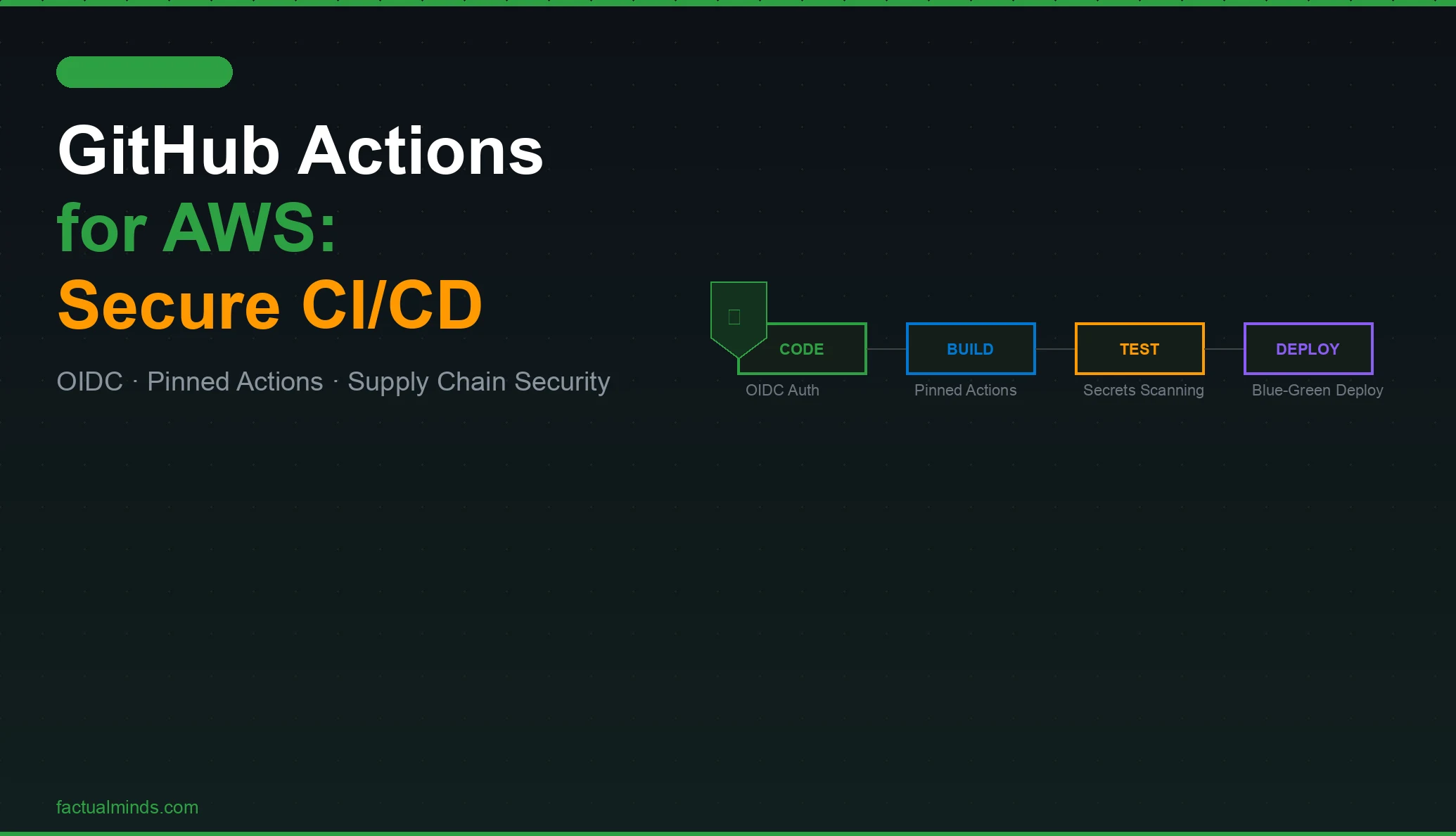
Production-grade GitHub Actions patterns for AWS workloads — OIDC authentication, pinned actions, blue-green deployments, build caching, and the security mistakes that leave your pipeline open to supply chain attacks.

Amazon SES is the most cost-effective email infrastructure for high-volume retail sending — but inbox placement requires dedicated IPs, proper authentication, and automated bounce handling. Here is how to do it right.

Black Friday breaks unprepared AWS environments. Here is how to architect retail infrastructure on AWS to handle 20x traffic spikes without downtime — covering auto-scaling, caching, database strategy, and the cost model.

A practical guide to AWS services, architecture patterns, and consulting considerations for retail and eCommerce teams — from core services to Black Friday readiness and PCI compliance.

Retail AWS architecture is different. Loyalty programs, pricing engines, inventory sync, and multi-CDN delivery require custom builds — not generic cloud templates. Here is how custom AWS development works for retail teams.

AWS Retail Competency validates consulting partners for verified retail delivery. Here is what the program means, what to look beyond the badge, and how to evaluate AWS partners for your retail workloads.

Manual security triage cannot keep up with cloud-scale threats. Here is how to wire GuardDuty Extended Threat Detection, Security Hub, EventBridge, and Lambda into a self-healing AWS security architecture.

Deploying GenAI without guardrails is a compliance incident waiting to happen. Here is how to build a production-grade AI governance layer on AWS using Amazon Bedrock Guardrails, least-privilege IAM, and continuous evaluation.

A practical guide to AWS Backup — backup plans, vault policies, cross-Region and cross-account copies, RPO/RTO alignment, and the data protection patterns that keep production workloads recoverable.

A practical guide to AWS CodePipeline — pipeline architecture, CodeBuild configuration, deployment strategies, cross-account pipelines, and the CI/CD patterns that ship code safely to production.

A practical guide to AWS Route 53 — hosted zones, routing policies, health checks, DNS failover, domain registration, and the traffic management patterns that make applications highly available.

A practical guide to AWS IAM — least privilege policies, IAM roles vs users, permission boundaries, SCPs, identity federation, and the access control patterns that secure production workloads without slowing teams down.

A practical guide to the 6 pillars of the AWS Well-Architected Framework and review process — what each pillar covers, why it matters, and how to apply it to your AWS workloads.

A practical guide to AWS auto scaling — target tracking, step scaling, scheduled scaling, predictive scaling, and the strategies that balance performance, availability, and cost across EC2, ECS, and Lambda workloads.

A practical comparison of AWS Secrets Manager and SSM Parameter Store — pricing, rotation, encryption, cross-account access, and clear guidelines for when to use each service for secrets and configuration management.

A practical guide to AWS SQS — standard vs FIFO queues, dead-letter queues, visibility timeout tuning, Lambda integration, and the messaging patterns that make distributed systems reliable.

A practical guide to migrating from SendGrid to Amazon SES — covering DNS cutover, IP warming, API changes, and deliverability preservation.

A practical guide to AWS VPC networking — CIDR planning, subnet strategies, NAT gateways, VPC endpoints, Transit Gateway, and the network architecture patterns that scale with your organization.

A practical guide to CloudFormation for production — stack organization, cross-stack references, drift detection, change sets, rollback strategies, and the practices that make infrastructure deployments safe and repeatable.

A detailed comparison of AWS CloudFront and Cloudflare for enterprise use — covering performance, pricing, security features, and integration trade-offs.

A practical guide to choosing between monolithic and microservices architectures on AWS — team size, deployment complexity, operational cost, and the patterns that help you choose the right approach for your stage.

A practical guide to AWS API Gateway — choosing between REST, HTTP, and WebSocket APIs, authentication patterns, throttling, caching, and the architecture decisions that determine API performance and cost.

A practical guide to ElastiCache Redis — caching patterns, data structures, cluster modes, eviction policies, and the strategies that reduce latency and database load in production applications.

A practical guide to AWS cloud cost management — Cost Explorer analysis patterns, budget alerts, anomaly detection, cost allocation tags, and the monitoring practices that prevent surprise bills.

A practical guide to AWS Cognito for SaaS authentication — user pools, hosted UI, social federation, multi-tenant patterns, token customization, and the architecture decisions that determine whether Cognito fits your application.

A practical comparison of AWS CodePipeline, GitHub Actions, and Jenkins for CI/CD on AWS — covering integration, cost, scalability, and team fit.

A practical guide to AWS WAF for production web applications — managed rule groups, custom rules, rate limiting, bot control, and the layered defense strategy that protects without blocking legitimate traffic.

A practical guide to AWS EventBridge for event-driven architectures — event buses, rules, schema discovery, cross-account patterns, and the design principles that make event-driven systems reliable.

A practical guide to AWS QuickSight for business intelligence — data source integration, SPICE performance, embedded analytics, row-level security, and cost-effective dashboard patterns.

A comprehensive guide to S3 security — bucket policies, encryption, access logging, Block Public Access, and the practices that prevent the data breaches that make headlines.

A practical comparison of Terraform and AWS CDK for infrastructure as code — language support, state management, multi-cloud vs AWS-native trade-offs, and when to choose each.

A practical guide to AWS CloudWatch for production observability — custom metrics, structured logging, alarm strategies, dashboards, and cost-effective monitoring patterns.

Architecture patterns for fintech applications on AWS — payment processing, fraud detection, regulatory compliance, and the services that power modern financial platforms.

How to build education platforms that scale from zero to millions of students using AWS serverless services — with architecture patterns for LMS, assessments, video delivery, and AI-powered learning.

How to deploy, tune, and operationalize Amazon GuardDuty for production threat detection — covering finding types, multi-account setup, automated response, and reducing false positives.

A practical comparison of Amazon ECS and EKS for container orchestration — covering architecture, operational complexity, cost, and decision criteria for choosing the right service.

Practical Step Functions patterns for production workloads — from sequential pipelines to parallel fan-out, error handling, human approval workflows, and cost optimization strategies.

A practical guide to AWS disaster recovery strategies — from backup-and-restore to multi-site active-active, with RTO/RPO targets, cost analysis, and implementation patterns.

A practical guide to DynamoDB single-table design for SaaS — covering access patterns, tenant isolation, GSI strategies, and the patterns that make DynamoDB the ideal serverless database.

How to structure your AWS organization with multiple accounts for security, compliance, and cost isolation — using AWS Organizations, Control Tower, and a well-designed landing zone.

A practical guide to Lambda pricing models, memory tuning, Graviton savings, and when Provisioned Concurrency pays for itself versus standard on-demand invocations.

A practical guide to building a modern data lake on AWS using S3 for storage, Glue for ETL, and Athena for serverless SQL analytics — with architecture patterns and cost optimization.

A realistic breakdown of the total cost of managing AWS infrastructure in-house versus outsourcing to an AWS managed services provider — covering staffing, tooling, risk, and opportunity cost.

Recognizing when to bring in expert help for your AWS migration strategy can save months of delay and thousands in wasted spend. Here are 7 signs it is time.

A practical guide to SaaS multi-tenancy architecture on AWS — comparing silo, pool, and bridge isolation models with trade-offs for cost, security, compliance, and operational complexity.

A practical comparison of Amazon RDS and Aurora — covering performance, pricing, availability, and the real-world scenarios where each option makes sense.

A practical comparison of Amazon Q for Business and ChatGPT Enterprise for enterprise AI assistants — covering data security, integrations, cost, and deployment models.

A practical checklist for building and maintaining HIPAA-compliant infrastructure on AWS — covering the BAA, eligible services, encryption, access controls, and audit requirements.

Building generative AI on AWS? Amazon Bedrock removes the complexity of training and hosting foundation models, letting businesses deploy production LLM apps faster, more securely, and at lower cost.

Beyond Reserved Instances — practical FinOps and AWS cost optimization strategies to reduce your AWS bill by 20-40% without sacrificing performance or reliability.

IAM best practices, GuardDuty, Security Hub, and the layered approach to AWS security consulting that keeps your workloads protected.
Our articles share what we know. Our consulting engagements apply that knowledge to your specific AWS environment.